Singapore COE Trends and Car Ownership (2011-2026)
18 March 2026
Plan your commute with SG Traffic Map!
Visit sgtrafficmap.com to view current and historical traffic camera images across Singapore. Check traffic conditions before you leave, or analyze past patterns to plan your travel routes more effectively.
Singapore's Certificate of Entitlement (COE) system is one of the most sophisticated vehicle ownership management schemes globally. Over the past fifteen years, COE prices have swung from relative affordability to record highs exceeding $128,000. This guide examines the structural dynamics of the COE market, its interplay with household income, the evolving car population, and the disruptive influence of private-hire vehicles (PHVs).
Whether you're considering buying a car in Singapore or simply want to understand why COE prices have reached six-figure levels, this analysis provides the data-driven insights you need.
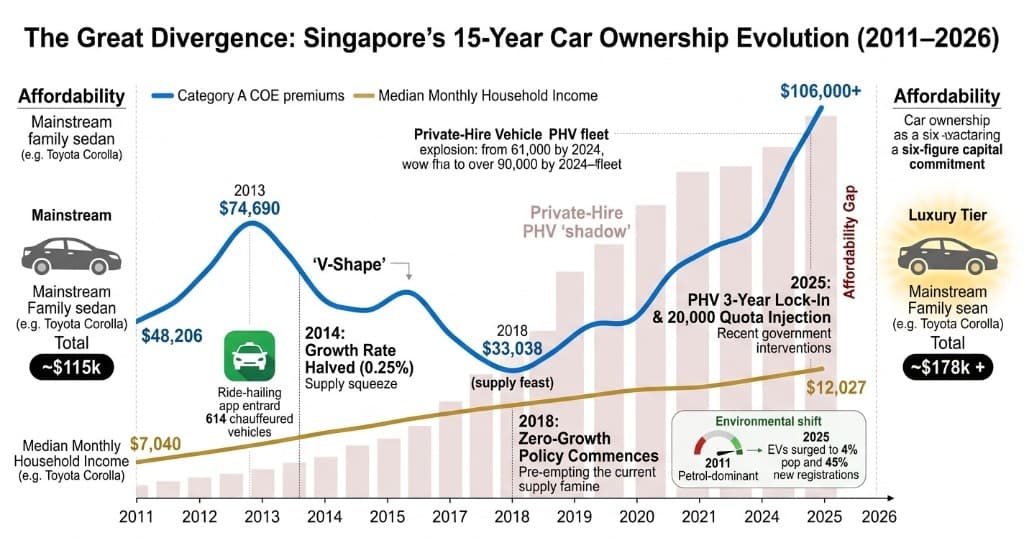
1. The Vehicle Quota System and Zero-Growth Policy
The Vehicle Quota System (VQS) regulates Singapore's car population to match road network capacity. Roads occupy approximately 12% of Singapore's land area, with limited scope for expansion. The government has shifted toward a "car-lite" paradigm, decoupling vehicle ownership from population growth.
Key Policy Milestones:
- October 2014: Land Transport Authority (LTA) halved the annual vehicle growth rate from 0.5% to 0.25%.
- February 2018: Growth rate for cars (Categories A and B) and motorcycles cut to zero.
- Extended to January 2028: Every new vehicle must be offset by deregistration of an existing one.
The Impact:
This structural scarcity creates a "feast and famine" cycle. COE supply depends on deregistrations from vehicles registered a decade prior. High sales in the past lead to abundant COEs later; low sales cause supply crunches. Demand—driven by population growth and rising affluence—collides with an inelastic supply curve, driving price volatility.
Evolution of COE Quota Allocation Parameters
| Parameter | Historical (Pre-2014) | Transition (2014–2018) | Current (2018–2026) |
|---|---|---|---|
| Annual Vehicle Growth Rate | 0.5% to 1.5% | 0.25% per annum | 0% for Cars/Motorcycles; 0.25% for Cat C |
| Quota Determination | Rolling deregistrations + growth | 0.25% growth + deregistrations | Rolling average of past 4 quarters |
| Regulatory Reviews | Periodic | Biennial | Triennial |
| Reclassification | Primarily based on CC | Power-based (97kW) | Integrated EV power ratings (110kW/130bhp) |
2. COE Price Trends: 2011 to 2026
Fifteen years of COE data reveal three distinct phases: recovery and tightening (2011-2014), supply feast and softening (2015-2019), and unprecedented supply famine (2020-2026).
The Data:
- 2013: Average COE premium reached $74,690, with peaks exceeding $92,000 for larger cars.
- 2016-2018: Quota increased from 2006 deregistrations; average premium fell to $49,587 (2016) and $33,038 (2018).
- 2023: Average premium rose to $94,538.
- October 2025: Category A (mainstream) premiums exceeded $128,000.
- March 2026: Category A closed at $108,220, Category B at $114,002.
Notable Anomaly:
In February 2026, Category A premiums ($106,501) exceeded Category B ($105,001) for the first time in almost six years—a reversal driven by ARF and PARF changes that disproportionately affected the luxury segment.
Historical Analysis of Yearly Quotas and Average Pricing
| Year | Total Yearly Quota | Highest Premium (S$) | Average Premium (S$) |
|---|---|---|---|
| 2011 | 13,026 | 56,112 | 48,206 |
| 2012 | 12,909 | 81,889 | 63,898 |
| 2013 | 8,534 | 92,100 | 74,690 |
| 2014 | 12,230 | 78,602 | 67,675 |
| 2015 | 32,867 | 68,589 | 60,601 |
| 2016 | 48,734 | 55,200 | 49,587 |
| 2017 | 45,282 | 52,000 | 45,991 |
| 2018 | 38,872 | 41,400 | 33,038 |
| 2019 | 32,846 | 36,704 | 29,907 |
| 2020 | 18,425 | 40,714 | 35,404 |
| 2021 | 19,306 | 58,801 | 47,304 |
| 2022 | 13,179 | 90,589 | 75,809 |
| 2023 | 15,235 | 106,000 | 94,538 |
| 2024 | 23,520 | 103,799 | 90,495 |
| 2025 | 29,289 | 128,105 | 102,912 |
| 2026 (YTD) | 5,140 | 109,501 | 106,083 |
3. Car Population Shifts: Engine Size and Fuel Type
Singapore's car population has transformed qualitatively. The composition is segmented by engine capacity (CC rating), power output (kW), and fuel type—all of which determine COE category and taxation banding.
Distribution of Car Population by CC Rating (2011–2024)
| CC Rating Segment | 2011 | 2015 | 2019 | 2024 |
|---|---|---|---|---|
| 1,000 cc & Below | 6,622 | 5,799 | 8,268 | 34,670 |
| 1,001 cc to 1,600 cc | 329,957 | 321,082 | 357,982 | 362,967 |
| 1,601 cc to 2,000 cc | 157,846 | 162,791 | 179,104 | 175,355 |
| 2,001 cc to 3,000 cc | 92,432 | 93,358 | 71,887 | 70,819 |
| 3,001 cc & Above | 16,866 | 19,281 | 13,355 | 13,933 |
| Total Population | 603,723 | 602,311 | 630,596 | 657,744 |
The "1,000 cc & Below" segment grew over fivefold from 6,622 (2011) to 34,670 (2024), driven by turbocharged downsizing that allows more powerful vehicles to qualify for Category A. The mid-range "1,001 cc to 1,600 cc" remains dominant.
Electric Vehicle Surge:
By end-2024, fully electric vehicles accounted for 4% of the car population—a 120% increase from the previous year. The Vehicular Emissions Scheme (VES) and Electric Vehicle Early Adoption Incentive (EEAI) offer rebates up to $45,000. Diesel-only passenger car registrations ceased in 2024.
4. Household Income and the Affordability Crisis
Median monthly household employment income grew from $7,040 (2011) to $12,027 (2025). Yet COE premiums have outstripped income growth for the 80th percentile of households, making car ownership increasingly difficult for the upper-middle class.
Median Monthly Household Employment Income Trends (2011–2025)
| Year | Median Income (S$) | Real Change (%) | Income per Member (S$) |
|---|---|---|---|
| 2011 | 7,040 | 5.5 | 1,997 |
| 2013 | 7,882 | 1.7 | 2,250 |
| 2015 | 8,673 | 4.9 | 2,503 |
| 2017 | 9,044 | 1.5 | 2,706 |
| 2019 | 9,442 | 0.9 | 2,930 |
| 2021 | 9,544 | 1.6 | 3,033 |
| 2023 | 10,882 | 2.7 | 3,507 |
| 2024 | 11,314 | 1.4 | 3,621 |
| 2025 | 12,027 | 5.4 | 3,909 |
Car Price Escalation:
- Toyota Corolla Altis: $114,888 (2015) to $162,888 (2025)—42% increase.
- Toyota Camry: $151,888 to $257,888—70% increase.
- BMW 5 Series: $240,800 to $354,055—47% increase.
- Mercedes E-Class: 56% increase to $407,338.
With entry-level new cars starting around $140,000, car ownership has become a six-figure capital commitment.
5. Private-Hire Vehicles and the COE Market
Ride-hailing platforms have altered COE demand. PHV population grew from negligible (2013) to over 90,000 units (2024)—approximately 13% of the total car population.
Surprising Data:
Leasing companies' share of Category A and B COEs fell from 26% (2022) to ~10% (2024). Individual Singapore residents won 84% of car COEs in late 2024. Private demand—bolstered by rising affluence—is the primary driver.
Qualitative Impact:
PHVs exert influence as "marginal price setters" in uniform-price auctions. PHV drivers average 350-400 km daily (vs. 55 km for private cars), accelerating depreciation and creating faster replacement cycles that pressure the COE quota.
Three-Year Lock-In (February 2025):
New regulation requires PHV-registered vehicles to be retained for minimum three years, preventing companies from "flipping" COEs into the used-car market. Previously, ~1,500 PHVs were converted to private use annually within three years.
6. Taxation: ARF, PARF, and the Green Transition
The government utilizes vehicle taxation to manage population, social progressivity, and environmental goals. The Additional Registration Fee (ARF) is based on the car's Open Market Value (OMV). In February 2023 and again in early 2026, the ARF structure was revised to impose higher rates on luxury vehicles.
Revised ARF Banding (2026)
| OMV Band | ARF Rate (% of OMV) |
|---|---|
| First $20,000 | 100% |
| Next $20,000 ($20,001 – $40,000) | 140% |
| Next $20,000 ($40,001 – $60,000) | 190% |
| Next $20,000 ($60,001 – $80,000) | 250% |
| Above $80,000 | 320% |
For a high-end luxury vehicle with OMV of $100,000, total ARF payable reaches $200,000—often exceeding the cost of the car and COE combined. The Preferential Additional Registration Fee (PARF) rebate—given to owners who scrap before the 10-year mark—was reduced by 45 percentage points and capped at $30,000 in early 2026.
EVs have become the most competitive segment. BYD displaced Toyota as Singapore's top-selling brand in 2025 with 21.2% market share. The Green Plan 2030 targets 60,000 charging points nationwide.
7. The Used Car Market
As new car prices soared, middle-income households have increasingly turned to the used car market. The Singapore used car market reached approximately $5.04 billion in 2025 and is projected to grow to $7.77 billion by 2031.
Used Car Market Segmentations and Projections (2025–2026)
| Market Segment | 2025 Revenue Share | 2026 Projected Size | CAGR (2026–2031) |
|---|---|---|---|
| Sedans | 52.64% | $2.85 Billion | 7.49% |
| SUVs & MPVs | ~25.0% | $1.35 Billion | 7.81% |
| Organized Dealers | 63.78% | $3.46 Billion | 6.51% |
| Online Booking | 27.11% | $1.47 Billion | 10.22% |
A five-year-old car such as a 2020 Toyota Corolla might list at around $85,000 in 2025—saving roughly $93,000 vs. new. However, rising COE premiums divert demand to pre-owned vehicles, driving up used prices. Reduced PARF rebates make deregistration more expensive, prompting some owners to renew COEs for 5 or 10 years instead of buying new, further tightening used inventory. Younger households earning below $8,000 monthly are the primary consumers of seven-year-old Japanese sedans, often financing for $60,000 to $80,000.
8. Future Outlook: 20,000 Quota Injection
The LTA will inject up to 20,000 additional COEs across categories from February 2025 to smooth the 10-year deregistration cycle. A peak in deregistrations is expected toward end-decade (from 2016-2018 registrations).
By 2040, the goal is for 9 in 10 peak-period trips via public, active, or shared transport. The convergence of ERP 2.0, an extensive rail network, and the PHV lock-in indicates a strategy where private ownership is economically de-prioritized in favor of a shared multimodal system.
Conclusion
Singapore's COE system has successfully capped the vehicle population at the cost of significant stratification. While household incomes have grown steadily, car ownership costs have escalated into the luxury tier. The rise of PHVs introduced commercial demand dynamics, though the three-year lock-in and power-based reclassification have begun to mitigate these effects. The Certificate of Entitlement remains the ultimate symbol of the trade-off between individual convenience and the constraints of a land-scarce city-state. The future of Singaporean mobility lies in optimizing shared and public transport—the core of its "car-lite" vision.